
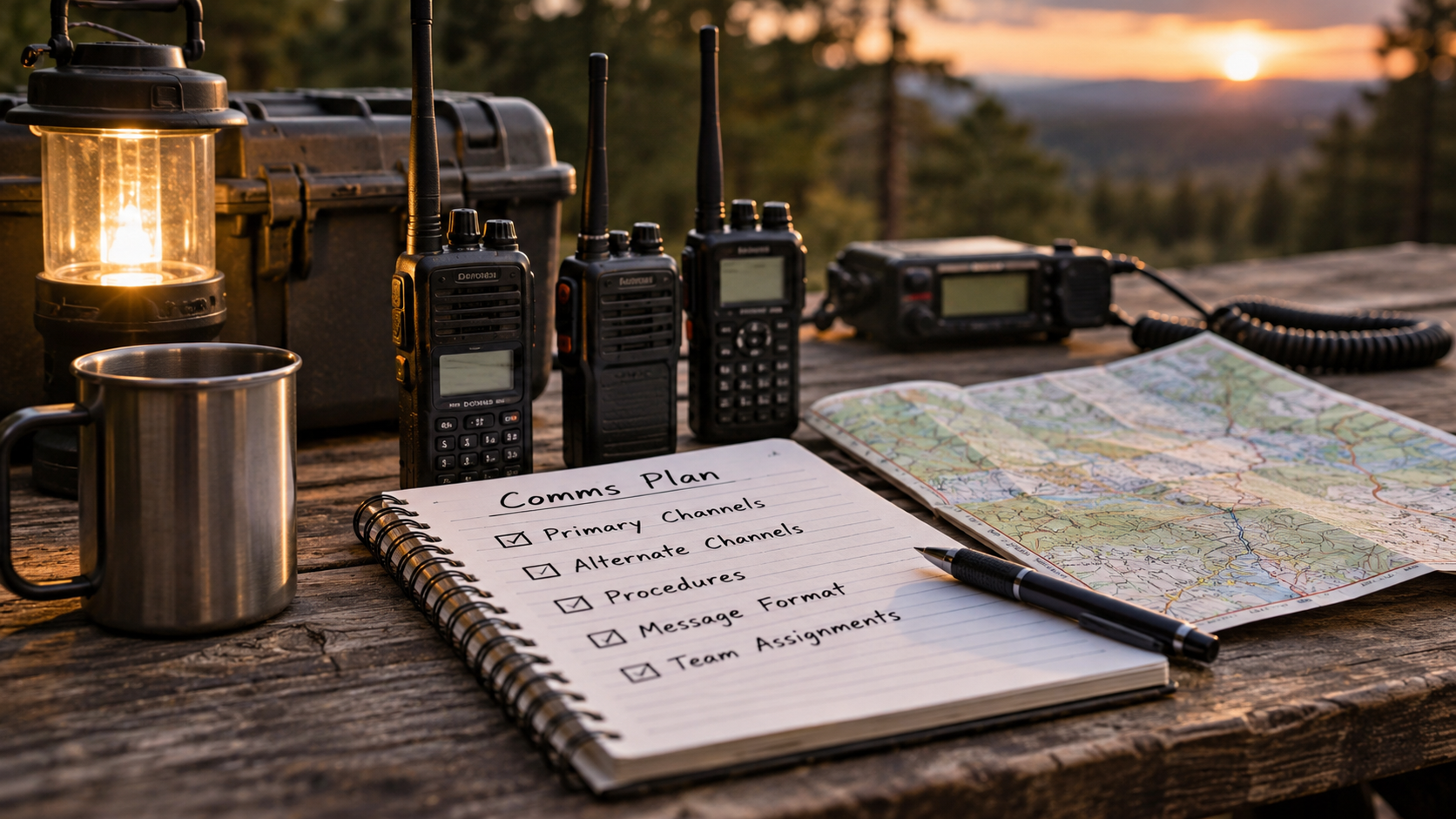
The 3 A.M. Test
It is three o'clock in the morning, and something has happened. The power is out, cellular service is intermittent, members of your family or group are separated, and someone needs to pass an important message.
So, someone picks up a radio, but they do not know which channel to use. They cannot remember the callsign, and they try the repeater, but the repeater is not responding. Nobody remembers the simplex fallback frequency. There are thirty channels programmed into the radio, but they are labeled with abbreviations only one person understands. And that person is not available.
Maybe he is asleep, maybe he is injured, maybe he has evacuated or is dealing with his own emergency, or maybe he is simply somewhere else. The group has radios, antennas, repeaters, battery banks, solar panels, and thousands of dollars invested in communications equipment. But, at three o'clock in the morning, none of that matters because the group does not actually have communications. It has equipment, and there is a difference.
Throughout Signal in the Storm, we have returned repeatedly to the distinction between equipment and capability. The same principle applies to the people responsible for communications, because a technically skilled operator can be an enormous asset. That same operator can also become a single point of failure. The question is not whether your communications specialist knows radios? The question is whether that knowledge has created capability throughout the group, or dependence upon the person who possesses it?
The Wizard Problem: Technical Skill Is Not the Mission
To be clear, this is not an argument against technical expertise. Technical knowledge matters; understanding propagation and antennas, knowing how to program radios, configure repeaters, select frequencies, troubleshoot equipment, and manage power all matter. But none of those things, by themselves, are the mission. The mission is moving accurate information between people who need it. That is the capability we are trying to create.
A communications specialist may hold an Amateur Extra license, understand digital modes, build antennas, program every radio in the group, and have a room filled with equipment. That knowledge is valuable, but if six ordinary people cannot use the communications system without that person standing beside them, the group has created a dependency, and dependencies become vulnerabilities. This is where hobby culture and mission requirements sometimes diverge. Because during an emergency, we are not trying to recreate a radio club meeting. Most people do not need to understand the technical architecture behind the network.
They need answers such as, who needs help? Where are they? What happened? What resources are needed? Where should people go? What changed? Under those circumstances, those questions matter more than whether the person holding the radio understands antenna theory. The best communications system is not necessarily the most sophisticated one, it is the one people can actually use when conditions are bad. This is what I think of as the wizard problem; when a technical question arises, someone says, "Ask the comms guy. He knows all that stuff." That sounds reassuring, but if everything depends upon the wizard, you may have just identified the communications system's greatest weakness.
Gatekeeping, Ego, and the Indispensable Expert
The wizard problem does not always develop deliberately. Someone becomes the designated communications person because they know more about radio than everyone else. So they program the radios, maintain the frequency lists, they know the passwords, keep the programming files, and configure the antennas. When something needs to be changed, everyone brings the equipment back to them. Over time, radio knowledge becomes their domain, and that may be unintentional, but it is still a form of gatekeeping. And gatekeeping can be surprisingly comfortable for the gatekeeper. Being indispensable feels important, because people need you. They come to you for answers, and you are the expert. The problem is that the more knowledge remains centralized, the more fragile the system becomes, and the communications specialist can quickly become a bottleneck.
Imagine one person monitoring several radios, scanners, message groups, news feeds, and an emergency net. He knows everything, but unfortunately, nobody else does. Information has been collected, but it has not been distributed, and that is not an effective communication strategy. Territorialism creates another version of the same problem. Arguments develop over brands, bands, analog versus digital, procedures, or whose communications plan is technically superior. Most of those arguments become irrelevant once an emergency begins, and a communications leader should be distributing knowledge, authority, information, and capability. Not accumulating them. Which leads to a principle that initially sounds counterintuitive, in that, the better the comms guy becomes at the actual job, the less indispensable he should become.
Equipment Complexity and the Human Factor
The communications specialist probably likes radios, and that is often why they became the communications specialist. Naturally, this person may be attracted to equipment with more features, more bands, more modes, more menus, and more programming options. But the radio that fascinates an experienced operator may be a terrible radio for everyone else.
Sometimes, ten inexpensive standardized radios create more usable capability, than five technically superior radios using different batteries, chargers, accessories, programming software, and menu structures. Standardization, common accessories, common charging systems, and familiarity all matter. A simple radio everyone understands may be more valuable than a sophisticated radio nobody wants to touch.
The same principle applies to procedures. It is easy to overengineer communications with complicated channel structures, multiple modes, elaborate call procedures, and fallback plans requiring fourteen steps to execute. The plan may look impressive on paper, and then someone has to use it while cold, tired, frightened, injured, or rushed. That is the real test, if someone can read through that plan and make it work?
Technical jargon can sometimes create another barrier. Callsigns, acronyms, and standardized terminology have legitimate purposes, particularly when everyone understands them. But jargon should facilitate communication, not just demonstrate expertise; sometimes plain language communicates faster. Teaching ability matters for the same reason, because someone can understand radios extremely well and still be terrible at teaching them. If every beginner's question receives a lecture, an eye roll, or a sarcastic response, eventually people stop asking questions. That can become problematic, because the question someone was afraid to ask during training can become the mistake they make during an emergency.
Temperament, therefore, becomes part of communications capability. If inexperienced operators are afraid to use the system because they might do something wrong, the system has already failed one of its most basic requirements. Technical people sometimes design systems for ideal operators, but emergencies give us actual human beings. People may install batteries incorrectly, forget callsigns, accidentally key microphones, or press the wrong button. Nobody remembers a fourteen-step procedure at three o'clock in the morning. As conditions deteriorate, the communications system should become simpler, not more complicated.
If It Isn't Documented and Tested, It Doesn't Exist
Suppose your communications specialist disappears tomorrow. Where is the channel plan, where are the programming backups, what is the fallback frequency, how is equipment and batteries rotated, and what happens when the repeater fails? If the answer is, "the comms guy knows," then the organization does not possess that knowledge, because it's confined to one person. Documentation is helpful in converting personal knowledge into organizational knowledge, and that doesn't necessarily require a hundred-page communications manual.
In many cases, the most useful operational documentation is extremely simple:
- Primary: Channel 3.
- Fallback: Channel 5 simplex.
- Radio failure: Attempt SMS.
- Complete communications loss: Proceed to the predetermined rally point.
That is useful at three o'clock in the morning. Quick-start instructions, laminated channel cards, contact information, programming backups, and contingency procedures all reduce dependence upon memory. But documentation is only part of the answer, because the system also must be tested. "We have radios" is not a communications plan. Have you actually used them from the places where people will be? Inside buildings, between vehicles, across the valleys and ridgelines in your operating area, and with the people who will actually use them? Radio waves do not care what range is printed on the box. Terrain, buildings, elevation, antenna placement, and operating conditions determine what works.
Repeaters deserve the same scrutiny. They are useful infrastructure, but they can also lose power, become overloaded, suffer equipment failures, or simply be outside your coverage area. If losing one repeater collapses the communications plan, the repeater has become a single point of failure.
Power can create another. Where are the spare batteries, how are they rotated, can they be charged without grid power? Are vehicle charging, power banks, generators, or solar available where appropriate, and when does power conservation begin? These questions should be answered before the batteries are empty.
Drills allow us to test all of this. Turn off the repeater without telling everyone, remove the primary communications operator from the exercise, hand a radio to someone who rarely uses one, change the rally point, and ask someone to locate the fallback instructions without assistance. The objective is not to make people fail, it is to discover where failure occurs while failure is still inexpensive. If the drill collapses, good, you learned something. Fix it, then do it again.
The Message Matters More Than the Radio
There is another problem that equipment cannot solve. The radios can work perfectly, everyone can be on the correct frequency, and the group can still communicate badly. Routine traffic and emergency traffic need to be distinguishable. Otherwise, casual conversation can occupy the same channel needed for something important. Message discipline matters, rambling creates problems, talking over other stations creates problems, and unnecessary repetition can waste time. Failing to acknowledge critical information leaves everyone uncertain about whether the message was received. During an emergency, information should increasingly become actionable.
A useful framework is simple:
- Who?
- What?
- Where?
- When?
- What is their condition?
- What is needed?
That is different from transmitting information merely because it is interesting. The same principle applies to monitoring, because more information does not automatically create better situational awareness. A room filled with scanners, radio nets, news feeds, and social media can eventually produce so much information that the operator can no longer determine what matters.
Information should support decisions based on what changed, who needs to know, and does this require action? If so, move that information to the people who can act upon it. This is why the communications planning is larger than just operating a radio, because it is part of an information system. The radio is simply one mechanism for moving information through it.
Your Radio Network Doesn't Exist in Isolation
A communications plan built entirely around one person's preferred equipment ignores the world outside the group. Your family may not own that equipment; your neighbors probably do not. Another group may use different radios or bands, and volunteers will arrive with whatever they have. Professional responders operate within their own systems, and that is why interoperability matters. That does not mean everyone needs access to every network; it means communications planning must acknowledge that other people and other systems exist.
It also means recognizing that radio is not always the best communications method. Phones, SMS, satellite messengers, internet-based systems, written messages, signage, physical messengers, and predetermined meeting points all have roles depending upon the situation. A communications plan that treats radio as the only option has already created a single point of failure before the first emergency begins.
Security requires similar judgment, because not everything you know needs to be transmitted. Names, medical information, inventories, movement plans, and sensitive locations may not belong on the air. Sometimes the most secure transmission is the one you do not make. Encryption does not eliminate that problem, because communications security also involves device custody, metadata, compromised operators, message content, and simple discretion. Encryption can protect information in transit, but it cannot compensate for poor judgment.
Regulatory judgment belongs here as well, and operators should understand and follow the rules governing the services they use during normal operations. At the same time, communications planning should remain focused on building legitimate capability rather than turning every training discussion into an argument over regulations. The mission still matters, and so does judgment.
Build a System That Fails Gracefully
Eventually, something will fail, and the important question is not whether Plan A can fail? It is what everyone does when there is a failure? If the primary channel becomes unusable, where do you go? If the repeater fails, do you switch to simplex? If radio becomes unreliable, do you attempt a phone call or SMS? Is satellite messaging available? If electronic communications disappear entirely, where is the physical rally point? At what point does someone carry a written message? Those decisions should not be invented during the emergency, and everyone should understand a simple principle. If X fails, do Y, not, "If X fails, call the comms guy and ask what to do." A resilient system does not require every layer to survive, it requires enough independent pathways that losing one does not create isolation.
The same principle applies to backup comms personnel. Who is the second? If that person is unavailable, who is third? A succession plan does not require turning every member into a radio expert, it only requires enough people to perform the essential functions that losing one individual does not collapse the system. Documentation distributes knowledge, training distributes skill, and practice tells you whether either one worked.
Conclusion: The Best Comms Guy Makes Himself Replaceable
Let's return to three o'clock in the morning. Something has happened, and your primary communications person is unavailable. The repeater is down, and the least technically experienced adult in the group picks up a radio. Can that person receive an important message? Can they understand it, and send an appropriate response? If the primary system fails, do they know what comes next? Can they find the fallback plan, and can they continue communicating without calling the comms guy?
If the answer is yes, you have probably built something useful. If the answer is no, buying another radio probably will not solve the problem. A good communications specialist should be working toward almost the opposite of indispensability. Standardize equipment where practical, simplify procedures, document the system, train several people, test failures, distribute information, and account for human limitations. Design the system so someone with very little technical knowledge can still accomplish the communications mission.
Those measures do not make expertise less valuable; it demonstrates that the expert understands what the expertise is actually for. This reaches beyond communications, because resilience is not created by eliminating failure. Equipment will fail, plans will encounter conditions nobody anticipated, people will become tired, injured, distracted, or unavailable. Resilience comes from building systems capable of absorbing those failures without immediately collapsing. People are part of those systems, and people can become single points of failure just as easily as repeaters, batteries, antennas, vehicles, or power supplies.
So, perhaps the measure of a good communications expert is not the number of radios owned, the class of license held, the frequencies memorized, or the sophistication of the network. Perhaps the measure is much simpler, how little does everyone else need that person once the emergency begins?
—PCG